
DOT Physical Release Form: What Your Own Doctor Must Provide
Published · Checked
Short answer
FMCSA has no general release or clearance form for your own doctor. What exists are condition-specific forms: MCSA-5870 for insulin-treated diabetes and MCSA-5871 for vision below the standard in one eye are required, while MCSA-5872 for diabetes without insulin and MCSA-5895 for medicines are optional. For anything else the examiner may ask for records or a letter from your treating provider. Your doctor informs the decision; the certified medical examiner makes it.
Key facts
- If you use insulin, your treating clinician completes Form MCSA-5870 and the exam must start no later than 45 days after they sign it. 49 CFR 391.46
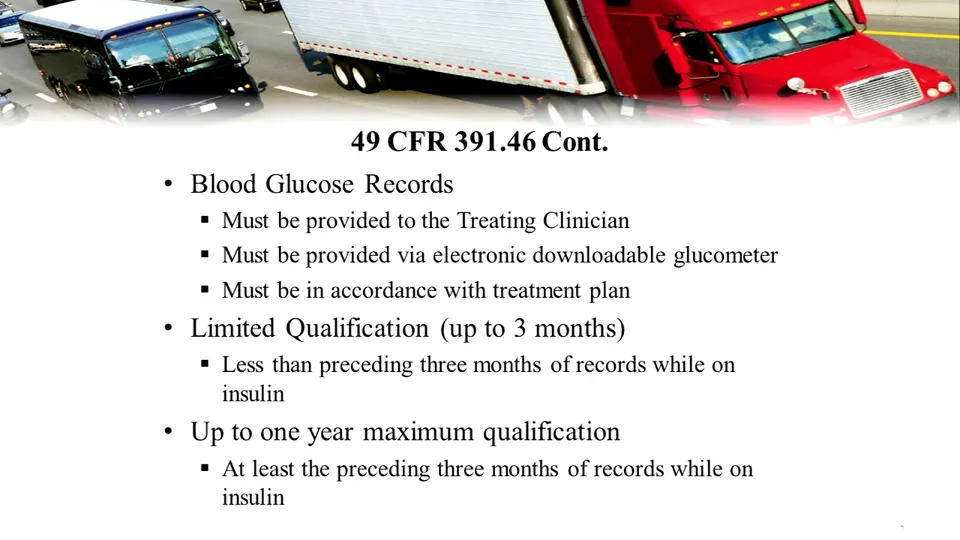
- Without at least 3 months of electronic blood glucose records given to your clinician, the card can last no more than 3 months; with them, up to 12 months. 49 CFR 391.46
- If the examiner needs more information, you have 45 days to provide it or complete the exam, and the pending status is reported to FMCSA. 49 CFR 391.43
- Form MCSA-5895 is optional: it asks the practitioner who prescribed your medicine whether it will adversely affect safe driving. FMCSA, MCSA-5895
Build your document checklist
Pick your conditions and get a printable list of what to bring from your own doctor, with the official form names.
How to use the list
- Nothing ticked still gives you the items every driver brings.
- Ask your doctor early: forms MCSA-5870 and MCSA-5871 have to be signed no more than 45 days before the exam.
- Print the list or save it as a PDF and take it to your doctor and to the exam.
- Call the examiner's office too. They may ask for more.
Not medical advice. The tool reads FMCSA's published standards and guidance. The certified medical examiner decides at your exam, using their own readings and judgment.
Is there an official DOT physical release form?
No. FMCSA publishes forms for insulin-treated diabetes, for vision below the standard in one eye, and two optional ones for diabetes without insulin and for medicines. There is no general "doctor's release" form. When an examiner asks for a release or clearance letter, they mean records or a letter from the provider who treats you.
The FMCSA document named "Medical Release Form" is something else. It is an authorization to release your medical records, part of the hearing and seizure exemption applications.
Your doctor's paperwork does not decide the outcome. The Medical Examiner's Handbook says: "While treating providers and specialists may provide additional medical information or consultation, the ME decides ultimately whether an individual meets the Federal Motor Carrier Safety Administration's (FMCSA) physical qualification standards." Medical Examiner's Handbook 2024
FMCSA medical forms and who fills them in
| Form | Name | Who completes it | When |
|---|---|---|---|
| MCSA-5875 | Medical Examination Report Form | You fill in the health history; the examiner fills in the rest. | Every exam |
| MCSA-5876 | Medical Examiner's Certificate | The examiner, if you qualify. This is the medical card. | Issued at the exam |
| MCSA-5870 | Insulin-Treated Diabetes Mellitus Assessment Form | The clinician who manages your diabetes and prescribes your insulin. | Required if you use insulin; the exam starts no later than 45 days after it is signed |
| MCSA-5871 | Vision Evaluation Report | An ophthalmologist or optometrist. | Required for the alternative vision standard; the exam starts no more than 45 days after it is signed |
| MCSA-5872 | Non-Insulin-Treated Diabetes Mellitus Assessment Form | Your treating provider, if the examiner asks for it. | Optional |
| MCSA-5895 | 391.41 CMV Driver Medication Form | The licensed practitioner who prescribed your medicine, with your consent. | Optional |
You fill in the health history on MCSA-5875 yourself at the start of the exam. It has 32 health questions and asks about every medicine you take, prescription or not. The examiner reviews each yes together with any medical records you bring.
Insulin-treated diabetes: Form MCSA-5870
This is the one form that is never optional if you use insulin. The person who completes it is your treating clinician, which 49 CFR 391.46 defines as "a healthcare professional who manages, and prescribes insulin for, the treatment of the individual's diabetes mellitus". 49 CFR 391.46
What to plan for:
- Glucose records first. Give the clinician at least the preceding 3 months of readings from an electronic glucometer that stores every reading with its date and time. Without them the card can last 3 months at most.
- Then the form. The clinician completes, signs and dates MCSA-5870.
- Then the exam, within 45 days. The examiner has to receive the form and begin the exam no later than 45 days after the signature.
- Every year. The card lasts up to 12 months, so the cycle repeats at least once a year.
After a severe low, one that needed help from someone else or caused loss of consciousness, a seizure or coma, you must stop driving until your clinician has found the cause addressed and completed a new MCSA-5870. Keep that form for your next exam.
Vision below the standard in one eye: Form MCSA-5871
An ophthalmologist or optometrist completes the Vision Evaluation Report, not your family doctor. It includes formal perimetry of each eye, and the exam has to start within 45 days of the signature. Our blood pressure and vision guide has the full standard and a checker.
Medicines: Form MCSA-5895
If you take a narcotic, an amphetamine or another controlled medicine on Schedules II through V, you can still qualify. The practitioner who prescribed it has to know your medical history and advise that it will not adversely affect safe driving. MCSA-5895 is FMCSA's optional way to put that in writing; a signed letter saying the same can also work, and the examiner may use either.
Documents to bring, by condition
Everyone
- A photo ID such as your CDL or driver's license. The examiner records which photo ID was used. FMCSA, MCSA-5875
- A list of everything you take: prescription, over-the-counter, herbal remedies and diet supplements. The health history on MCSA-5875 asks for it. FMCSA, MCSA-5875
- A list of past surgeries with what was done. The form asks you to list and explain them. FMCSA, MCSA-5875
- Your glasses or contact lenses and your hearing aid, if you use them. The vision and hearing tests may be passed with them. 49 CFR 391.41
Diabetes treated with insulin
- Form MCSA-5870, completed, signed and dated by the clinician who manages your diabetes and prescribes your insulin. The exam has to start no later than 45 days after the signature. 49 CFR 391.46
- Before that visit: at least the preceding 3 months of blood glucose records from an electronic glucometer that stores every reading with date and time. Without them the card can be no longer than 3 months. 49 CFR 391.46
- After a severe low (one that needed help from others, or caused loss of consciousness, a seizure or coma): a new MCSA-5870. Keep it and give it to the examiner at your next exam. 49 CFR 391.46
Diabetes without insulin
- Ask the examiner's office whether they use the optional form MCSA-5872. It asks your provider about the diagnosis, monitoring and stability of your diabetes. FMCSA, MCSA-5872
High blood pressure or blood pressure medicine
- Your medication list with doses. The certification decision uses the readings taken at the exam itself. Medical Examiner's Handbook 2024
- If you were treated after a high reading: records that show how high it was before treatment. When the examiner does not know that, FMCSA guidance recommends yearly certification. Appendix A to Part 391
Heart condition, stents, bypass, pacemaker or defibrillator
- Records from your cardiologist or treating provider: the diagnosis, each procedure with its date, current medicines and recent test results. For several heart conditions the handbook says the examiner could consider an evaluation by a cardiologist. Medical Examiner's Handbook 2024
- Under FMCSA guidance, bypass surgery and a pacemaker do not by themselves rule you out. An implantable defibrillator is treated differently: it addresses an ongoing heart condition and is likely to cause fainting or collapse. Appendix A to Part 391
Sleep apnea
- Your sleep study result and records from your treating provider that show the treatment is working, for example data from your CPAP machine. FMCSA sets no format for this proof, so ask the examiner's office what they accept. Medical Examiner's Handbook 2024
Seizures or epilepsy
- Records from your neurologist with the date of your last seizure and the date you stopped antiseizure medicine. Under FMCSA guidance, a history of epilepsy can be certified after 10 years seizure-free and off medicine; a single unprovoked seizure after 5 years seizure-free and off medicine. Appendix A to Part 391
- If you do not meet those periods: FMCSA's seizure exemption application, which comes with FMCSA's Medical Release Form (an authorization to release your records). FMCSA medical forms
A narcotic, an amphetamine or another controlled medicine
- A written statement from the practitioner who prescribed it: they know your medical history and the medicine will not adversely affect your ability to drive safely. FMCSA's optional form MCSA-5895 can be used for this. Appendix A to Part 391
One eye below 20/40 with glasses, or a narrow field of vision
- Form MCSA-5871 from an ophthalmologist or optometrist, signed no more than 45 days before the exam, with a copy of the formal field-of-vision test for each eye attached. 49 CFR 391.44
- Without a completed MCSA-5871 you cannot be certified under the alternative vision standard, and the examiner cannot put the exam on hold to wait for it. Medical Examiner's Handbook 2024
Hearing loss
- Your hearing aid. If you still do not meet the standard with it, FMCSA's federal hearing exemption application and its Medical Release Form. FMCSA medical forms
Missing or limited use of an arm, hand, leg or foot
- Your Skill Performance Evaluation certificate, if FMCSA issued you one. Drivers qualified through one must carry a copy when on duty. 49 CFR 391.41
Anxiety, depression or other mental health treatment
- The name and dose of each medicine. FMCSA guidance asks examiners to weigh the side effects and interactions of these medicines. Appendix A to Part 391
Past alcohol use disorder
- If the examiner asks: documentation from a professional qualified to assess alcohol use, with an opinion on whether a current diagnosis is present or you are in remission. Appendix A to Part 391
What a doctor's letter should cover
No FMCSA form exists for a general doctor's release. If the examiner asks for a letter, ask what it must cover. A useful letter answers the handbook's own question and identifies the provider the way FMCSA's forms do.
- Your diagnosis and when it was made.
- Your treatment, with each medicine and dose.
- Whether the treatment is adequate, effective, safe and stable (the handbook's words).
- Side effects that could affect driving, or a note that there are none.
- The provider's full name, office address, phone number, signature and the date.
The handbook's question: Has treatment been shown to be adequate, effective, safe, and stable?
Medical Examiner's Handbook 2024
FMCSA's own forms end the same way: the provider's name, office address, phone number, signature and date. A letter with the same details is easy for the examiner to verify.
If the examiner puts your exam on hold
When the examiner needs more information, they can mark the exam as pending. You then have 45 days to bring it or finish the exam, and FMCSA is told the exam is pending. A pending exam does not extend your current card, so start early if your card is close to running out. The medical card expiration calculator shows how much time you have.
If you disagree with an examiner, you can see another certified examiner. The handbook expects you to give the second one the same medical information.
Video
Frequently asked questions
Does my primary care doctor decide whether I pass the DOT physical?
No. Your doctor can give the examiner information about your condition and treatment, but only a medical examiner on FMCSA's National Registry decides whether you meet the physical qualification standards.
How long is Form MCSA-5870 good for?
The exam has to start no later than 45 days after your treating clinician signs and dates the form. A new form is needed for every exam, at least once a year.
Can my family doctor fill out the vision form MCSA-5871?
No. Only a licensed ophthalmologist or optometrist can complete the Vision Evaluation Report, and the exam must begin within 45 days of their signature.
What happens if I forget the paperwork?
The examiner can put the exam on hold and give you up to 45 days to bring the missing information, or decide that you do not qualify. For the alternative vision standard there is no hold without a completed MCSA-5871.
Is there an FMCSA form for sleep apnea?
No. FMCSA sets no form, test or compliance format for sleep apnea. If you are treated for moderate-to-severe sleep apnea, bring records that show the treatment works and ask the examiner's office what they accept.
Sources
- 49 CFR 391.41, Physical qualifications for drivers (eCFR) ecfr.gov checked
- 49 CFR 391.43, Medical examination; certificate of physical examination (eCFR) ecfr.gov checked
- 49 CFR 391.44, Alternative vision standard (eCFR) ecfr.gov checked
- 49 CFR 391.46, Diabetes mellitus treated with insulin (eCFR) ecfr.gov checked
- 49 CFR Part 391, Appendix A, Medical Advisory Criteria (eCFR) ecfr.gov checked
- FMCSA Medical Examiner's Handbook, 2024 Edition fmcsa.dot.gov checked
- FMCSA, Medical Applications and Forms fmcsa.dot.gov checked
- FMCSA, Insulin-Treated Diabetes Mellitus Assessment Form, MCSA-5870 fmcsa.dot.gov checked
- FMCSA, Vision Evaluation Report, Form MCSA-5871 fmcsa.dot.gov checked
- FMCSA, Non-Insulin-Treated Diabetes Mellitus Assessment Form, MCSA-5872 (optional) fmcsa.dot.gov checked
- FMCSA, Medical Examination Report (MER) Form, MCSA-5875 fmcsa.dot.gov checked
- FMCSA, 391.41 CMV Driver Medication Form, MCSA-5895 (optional) fmcsa.dot.gov checked
- FMCSA, Medical Release Form (exemption applications) fmcsa.dot.gov checked
- FMCSA, New Diabetes Standard Overview Webinar fmcsa.dot.gov checked
Published November 27, 2026. Rules, quotes and figures checked against the official sources on November 27, 2026. This guide explains the rules; it is not legal or medical advice. Confirm with your state licensing agency or FMCSA.