
DOT Physical Blood Pressure and Vision Requirements
Published · Checked
Short answer
FMCSA guidance sorts blood pressure into stages. At 139/89 or lower the card can run up to 24 months. Stage 1 (140-159 over 90-99) gets 1 year, Stage 2 (160-179 over 100-109) a one-time 3 months, and Stage 3 (180 over 110 and up) no card until treatment brings you to 140/90 or less, then 6 months at a time. For vision you need 20/40 in each eye and with both eyes, glasses allowed, a 70° field in each eye and the ability to recognize red, green and amber. If one eye falls short, the alternative vision standard with Form MCSA-5871 may apply.
Key facts
- The federal rule itself gives no blood pressure number. It rules out a current diagnosis of high blood pressure likely to interfere with safe driving; the stages come from FMCSA's advisory criteria. Appendix A to Part 391
- A reading over 139/89 should be confirmed with a second measurement later in the same exam, and the readings taken at the exam are the ones used. Medical Examiner's Handbook 2024
- Vision: at least 20/40 in each eye and with both eyes, with or without corrective lenses, a field of at least 70° in the horizontal meridian in each eye, and recognizing standard red, green and amber. 49 CFR 391.41
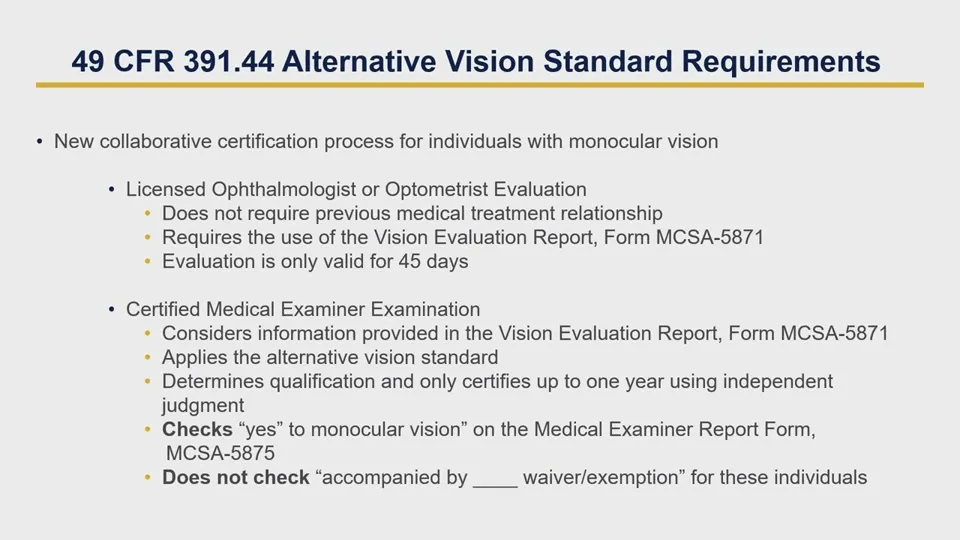
- Under the alternative vision standard the exam must begin within 45 days of the eye doctor signing Form MCSA-5871, and the card lasts 12 months at most. 49 CFR 391.44
Blood pressure checker
Type a reading to see which FMCSA stage it falls in and how long a medical card the guidance points to.
The four bands
- Below Stage 1139 or less / 89 or lessUp to 24 months. The blood pressure guidance does not shorten the card; the examiner can still issue a shorter one for another reason.
- Stage 1140-159 / 90-991 year, then a yearly exam at or below 140/90.
- Stage 2160-179 / 100-109One-time 3 months to start or adjust treatment; 1 year once you reach 140/90 or less.
- Stage 3180 or more / 110 or moreNo card until you are at 140/90 or less on treatment; then 6 months, and every 6 months after that.
The target in every band is 140/90 or less. When the two numbers fall in different bands, the checker uses the higher one. Appendix A to Part 391
Not medical advice. The tool reads FMCSA's published standards and guidance. The certified medical examiner decides at your exam, using their own readings and judgment.
Vision standard checker
Answer five questions to see whether the standard or the alternative vision standard fits you, and what to bring.
Two ways to meet the rule
20/40 in each eye, 70° field in each eye, red, green and amber. Card up to 24 months.
49 CFR 391.41One eye below the line, the better eye at 20/40 and 70°, plus Form MCSA-5871. Card up to 1 year.
49 CFR 391.44Not medical advice. The tool reads FMCSA's published standards and guidance. The certified medical examiner decides at your exam, using their own readings and judgment.
What blood pressure do you need to pass a DOT physical?
The regulation has no number. It says a driver qualifies if he or she "Has no current clinical diagnosis of high blood pressure likely to interfere with his/her ability to operate a commercial motor vehicle safely". 49 CFR 391.41
The numbers come from FMCSA's medical advisory criteria in Appendix A to Part 391. FMCSA calls them advisory: they guide the examiner but are not law. Under them, 139/89 or lower has no effect on the card, and each stage above it shortens the card or holds it back.
DOT blood pressure chart
| Stage | Systolic (top) | Diastolic (bottom) | Medical card | Source |
|---|---|---|---|---|
| Below Stage 1 | 139 or less | 89 or less | Up to 24 months. The blood pressure guidance does not shorten the card; the examiner can still issue a shorter one for another reason. | 49 CFR 391.45 |
| Stage 1 | 140-159 | 90-99 | 1 year, then a yearly exam at or below 140/90. | Appendix A to Part 391 |
| Stage 2 | 160-179 | 100-109 | One-time 3 months to start or adjust treatment; 1 year once you reach 140/90 or less. | Appendix A to Part 391 |
| Stage 3 | 180 or more | 110 or more | No card until you are at 140/90 or less on treatment; then 6 months, and every 6 months after that. | Appendix A to Part 391 |
Stages 1 and 2 are defined by the top number, the bottom number, or both, so one high number is enough. A reading of 159/89 is Stage 1 because of the 159. When the two numbers land in different stages, our checker above uses the higher one. Appendix A words Stage 3 with both numbers, 180 systolic and 110 diastolic, so a reading with only one number that high is a call for the examiner.
How the examiner takes your blood pressure
The handbook tells examiners to confirm any reading over 139/89 with a second one later in the same exam. That applies when only the top or only the bottom number is high. Appendix A adds: "An elevated blood pressure finding should be confirmed by at least two subsequent measurements." Appendix A to Part 391
The certification decision uses the readings taken at the exam. A log from home can help your own doctor, but it is not what the examiner certifies on.
If you take blood pressure medicine
Medicine does not disqualify you. The examiner checks two things: the reading on the day, and whether the medicine itself could affect driving. Appendix A warns that most blood pressure drugs have side effects, such as drowsiness or fainting, that have to be weighed one driver at a time.
How high your pressure was before treatment also matters. FMCSA's guidance says: "Annual certification is recommended if the medical examiner does not know the severity of hypertension prior to treatment." Records from your own doctor answer that question. Our guide to what your doctor should provide lists them. Appendix A to Part 391
Planning around a short card
A Stage 2 reading gives you a one-time 3-month card to start or adjust treatment and get to 140/90 or less. That is not much time, so see your own doctor soon after the exam. A Stage 1 card means a new exam every year. Use the medical card expiration calculator to set a reminder, and book the next exam before the card runs out.
DOT vision requirements
| Test | Standard (49 CFR 391.41) | Alternative (49 CFR 391.44) |
|---|---|---|
| Distance vision | 20/40 in each eye and 20/40 with both eyes, glasses or contacts allowed | 20/40 in the better eye, glasses or contacts allowed |
| Field of vision | 70° in the horizontal meridian in each eye | 70° in the better eye, measured by formal perimetry to at least 120° |
| Color | Recognize red, green and amber traffic signal colors | Same: there is no alternative for color |
| Paperwork | None beyond the exam form | Form MCSA-5871 from an ophthalmologist or optometrist, exam within 45 days of its signature |
| Longest card | 24 months | 1 year |
The standard is in 49 CFR 391.41(b)(10). Distance vision may be measured with your glasses or contacts. If you need them to pass, the examiner marks on the card that you wear corrective lenses.
What happens at the DOT eye exam
The examiner, or an ophthalmologist or optometrist, tests three things:
- Distance vision. A Snellen chart or a Titmus vision tester, one eye at a time and then both eyes.
- Side vision. Usually a confrontation test: you look at the examiner's nose and count fingers held out to the side, one eye closed at a time.
- Color. A color plate test such as Ishihara, or the red, green and amber on the chart. You pass if you can name those three colors, even with some color deficiency.
The handbook says "Contact lenses are permissible if there is sufficient evidence to indicate that the individual has good tolerance and is well adapted to their use." A contact lens for distance in one eye and one for near vision in the other is fine as long as you still meet the standard. Bioptic telescopic lenses are not allowed for driving a commercial vehicle. Medical Examiner's Handbook 2024
Vision in one eye: the alternative standard and Form MCSA-5871
Since the 2022 vision rule, a driver whose worse eye cannot reach 20/40 with lenses, or has a field under 70°, can still qualify. The old federal vision exemption program ended with it. In the handbook's words: "On March 22, 2023, all Medical Examiner's Certificates, Form MCSA-5876, issued with a vision exemption became void." Medical Examiner's Handbook 2024
The steps under 49 CFR 391.44:
- An ophthalmologist or optometrist examines you and completes the Vision Evaluation Report, Form MCSA-5871. Your field of vision has to be measured by formal perimetry that tests to at least 120°, and a copy of the test is attached.
- You see a certified medical examiner within 45 days of the eye doctor's signature. Bring the completed form; without it you cannot be certified under this standard.
- The examiner applies the standard: in the better eye at least 20/40 and a 70° field, red, green and amber recognized, a vision loss that is stable, and enough time since it became stable to adapt.
- If you qualify, the card lasts 12 months at most, and you repeat steps 1 and 2 every year.
- The first time you qualify this way, your carrier gives you a road test, unless you drove a commercial vehicle with the same vision loss for the 3 years before, in intrastate or excepted work.
The checker at the top of this page runs your numbers through both standards and tells you which forms to bring.
Video
Frequently asked questions
Is 140/90 a pass on a DOT physical?
Yes, but with a shorter card. FMCSA guidance puts 140 systolic or 90 diastolic at the bottom of Stage 1, which points to a 1-year card. At later yearly exams the target is 140/90 or less.
Can you get a DOT medical card with high blood pressure?
Yes. High blood pressure only shortens the card in Stages 1 and 2. In Stage 3 (180 over 110 and up) the guidance says no card until treatment brings you to 140/90 or less; after that the card runs 6 months at a time.
Does taking blood pressure medicine fail a DOT physical?
No. The examiner looks at your reading at the exam and at how your medicine affects you, since some cause drowsiness or fainting. If the examiner does not know how high your pressure was before treatment, FMCSA guidance recommends a yearly card.
Can I wear glasses or contacts for the DOT eye test?
Yes. Each eye may be corrected to 20/40 with glasses or contacts, and the examiner then marks on the card that you wear corrective lenses. Bioptic telescopic lenses are not allowed for driving a commercial vehicle.
Can you drive a truck with vision in only one eye?
Often, yes. Since 2022 the alternative vision standard lets you qualify if your better eye reaches 20/40 and a 70° field and an ophthalmologist or optometrist completes Form MCSA-5871. The card lasts up to 12 months, and the first time a road test is usually required.
Does color blindness disqualify you from a DOT physical?
Not by itself. You pass the color part if you can recognize standard red, green and amber, even with some color deficiency. If you cannot, neither the standard nor the alternative vision standard can be met.
Sources
- 49 CFR 391.41, Physical qualifications for drivers (eCFR) ecfr.gov checked
- 49 CFR 391.43, Medical examination; certificate of physical examination (eCFR) ecfr.gov checked
- 49 CFR 391.44, Alternative vision standard (eCFR) ecfr.gov checked
- 49 CFR 391.45, Persons who must be medically examined and certified (eCFR) ecfr.gov checked
- 49 CFR Part 391, Appendix A, Medical Advisory Criteria (eCFR) ecfr.gov checked
- FMCSA Medical Examiner's Handbook, 2024 Edition fmcsa.dot.gov checked
- FMCSA, Vision Evaluation Report, Form MCSA-5871 fmcsa.dot.gov checked
- FMCSA, New Vision Standard Overview Webinar fmcsa.dot.gov checked
Published November 27, 2026. Rules, quotes and figures checked against the official sources on November 27, 2026. This guide explains the rules; it is not legal or medical advice. Confirm with your state licensing agency or FMCSA.