
How to Start a Trucking Company: USDOT, MC, IFTA
Published · Checked
Short answer
Register with FMCSA for a USDOT number, and get operating authority (the MC number) if you will haul regulated freight for pay. Name a process agent on Form BOC-3 and have at least the federal minimum insurance in effect before the first load. If your drivers need a CDL, set up drug and alcohol testing and Clearinghouse queries, then add IRP plates, an IFTA license and Form 2290 where they apply.
Key facts
- Minimum public liability: $750,000 for for-hire nonhazardous freight; $1,000,000 or $5,000,000 for hazardous materials. 49 CFR 387.9
- New carriers are monitored for 18 months; the safety audit comes once there are enough records, generally after at least 3 months. 49 CFR 385.307
- An owner-operator who is the only driver must be in a random testing pool of two or more covered employees. 49 CFR 382.103
- Form 2290 applies to vehicles with a taxable gross weight of 55,000 pounds or more; the current period runs July 1, 2026 to June 30, 2027. IRS
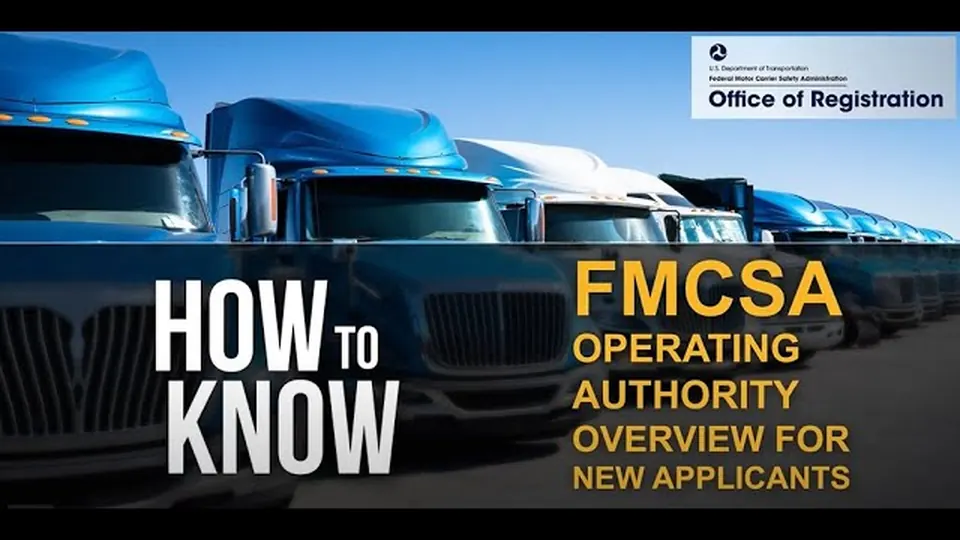
It's probably not news to you that starting a trucking company means registering with FMCSA. This practical guide explores what new trucking companies need to know about FMCSA registration, and how carriers can set up insurance, testing, and taxes.
| Step | What it is | Who needs it | Official source |
|---|---|---|---|
| USDOT number | FMCSA identification number; issued inactive and activated after the required filings; shown on each self-propelled truck after the letters "USDOT", with your legal or trade name | Motor carriers subject to the federal safety rules, before interstate operations | eCFR 390.201, 390.21 (eCFR marks both suspended) |
| Operating authority (often called an MC number) | Federal authority to haul regulated freight for pay; "MC number" is the common name, the rules say "operating authority" | For-hire carriers, unless the freight is exempt; not private carriers hauling their own goods | eCFR 385.301, 365.105 (marked suspended) |
| BOC-3 process agent | A person who can accept legal papers for your company, named on Form BOC-3 | Private and for-hire carriers that register | eCFR 390.205, part 366 (marked suspended) |
| Insurance | Minimum public liability in effect before the truck runs; for-hire and hazmat carriers file evidence with FMCSA within about 90 days of applying (FMCSA sets the exact deadline) | Motor carriers operating vehicles of 10,001 lb GVWR or more; amounts in the next table | eCFR 387.7, 387.9; filing deadline from 390.205 (marked suspended) |
| Drug and alcohol program | Testing program, random testing pool, pre-employment drug test | Employers of drivers who need a CDL, including owner-operators | eCFR part 382 |
| Clearinghouse queries | Full query with the driver's consent before the driver first performs safety-sensitive work, a query at least once a year, records kept 3 years | Employers of drivers subject to testing | eCFR 382.701, 382.703 |
| New entrant monitoring | 18 months of monitoring; safety audit once there are enough records, generally at least 3 months in | New US and Canada-based carriers | eCFR 385.307 |
| IRP apportioned plates | Plates and a cab card from your base state; fees only for states with actual travel | Trucks over 26,000 lb or with 3 or more axles, in 2 or more jurisdictions | Virginia DMV, Washington DOL |
| IFTA license | Fuel tax license from your base jurisdiction | Qualified motor vehicles in 2 or more member jurisdictions | IFTA Articles of Agreement |
| Form 2290 | Federal heavy vehicle use tax; the stamped Schedule 1 is proof of payment for state registration | Trucks with a taxable gross weight of 55,000 lb or more | IRS Instructions for Form 2290 |
Register with FMCSA: USDOT number and operating authority
Thinking about exactly what kind of freight you want to haul will help you decide what registrations to pursue. So, it is usually necessary to register with FMCSA for a USDOT number before you haul across state lines. But chances are, you'll also need operating authority, too.
Naming a process agent is another important step in your registration. A process agent can accept legal papers and is named on the BOC-3 form.
Insurance before the first load
The federal minimum insurance for a for-hire interstate truck hauling nonhazardous freight is $750,000. The required liability amount may vary depending on the type of material.
The federal insurance rule says: "No motor carrier shall operate a motor vehicle until the motor carrier has obtained and has in effect the minimum levels of financial responsibility". 49 CFR 387.7
| Type of carriage | Freight | Federal minimum |
|---|---|---|
| For-hire; interstate or foreign; 10,001 lb GVWR or more | Property (nonhazardous) | $750,000 |
| For-hire and private; interstate or foreign in any quantity, or intrastate in bulk only; 10,001 lb GVWR or more | Oil listed in 49 CFR 172.101; other listed hazardous materials, waste and substances not in the $5,000,000 row | $1,000,000 |
| For-hire and private; interstate, foreign or intrastate; 10,001 lb GVWR or more | Hazardous substances in bulk in cargo tanks, portable tanks or hopper-type vehicles; listed bulk Division 1.1, 1.2, 1.3, 2.1, 2.2, 2.3 (Hazard Zone A) and 6.1 (Packing Group I, Hazard Zone A) materials; highway route controlled quantities of Class 7 | $5,000,000 |
There are literally two levels of hazmat insurance, each with their own specific dollar amounts and covered material types. In insurance terms, the minimum coverage for oil and most listed hazmat is $1,000,000. The $5,000,000 requirement includes certain bulk hazmat but excludes most other listed materials.
Drug and alcohol testing when your trucks need a CDL
It's a fact of life for owner-operators to be both the employer and the driver. You're required to not only manage the testing program, but to comply with the rules as the driver.
FMCSA's drug and alcohol rule says: "An employer who employs only himself/herself as a driver shall implement a random alcohol and controlled substances testing program of two or more covered employees in the random testing selection pool." 49 CFR 382.103
You also generally need a verified negative pre-employment drug test before you first drive for the company.
You are required to run a full query with the driver's consent. You must query every driver in the FMCSA Clearinghouse at least once a year.
The first 18 months as a new carrier
You're going to be watched closely for the first 18 months as a new carrier.
FMCSA's new entrant rule says: "After a new entrant satisfies all applicable pre-operational requirements, it will be subject to the new entrant safety monitoring procedures for a period of 18 months." 49 CFR 385.307
You're being watched closely and getting a safety audit once you have enough records. Some new carriers may face stricter scrutiny than others, so you'll want to make sure you are prepared for an early audit when FMCSA reviews your records.
| What a new carrier does | What may follow |
|---|---|
| Uses a driver without a valid CDL (falsified, revoked, expired or missing a required endorsement) | Expedited safety audit, compliance review or a written response showing corrective action |
| Uses a driver who tests positive or refuses a required drug or alcohol test | Expedited safety audit, compliance review or a written response showing corrective action |
| Runs a truck without the required insurance | Expedited safety audit, compliance review or a written response showing corrective action |
Apportioned plates and the IFTA license
Set up apportioned IRP plates and a cab card with your home state. This requirement is for interstate operations and should be applied to trucks over 26,000 pounds. However, not all trucks that run across state lines are cut from the same cloth.
| Test | IRP apportioned plates (Virginia and Washington pages) | IFTA license (Articles of Agreement) |
|---|---|---|
| Weight | Over 26,000 lb (Virginia: registered gross or actual weight; Washington: GVW) | Two axles and over 26,000 lb gross or registered gross vehicle weight |
| Axles | Power unit with 3 or more axles, regardless of weight | 3 or more axles, regardless of weight |
| Combination | Actual or registered weight of the combination over 26,000 lb | Combination over 26,000 lb gross or registered gross vehicle weight |
| Where it runs | 2 or more IRP jurisdictions | 2 or more member jurisdictions, carrier based in a member jurisdiction |
| Apply to | Your base state | Your base jurisdiction |
| Not covered | Varies by state (Washington lists recreational vehicles, restricted farm plates, government vehicles, school buses) | Recreational vehicles |
Washington's Department of Licensing says: "You'll only be charged fees for jurisdictions you have actual travel." Washington DOL
Be aware that if you plan to haul across two or more member jurisdictions, you will usually need an IFTA license. You will want to apply to the home state agency and inquire about the IFTA license.
Heavy vehicle use tax (Form 2290)
In addition to a valid CDL, owner-operators may also owe the federal heavy vehicle use tax on IRS Form 2290. You will have a federal heavy vehicle use tax waiting for you once you first use a truck with a taxable gross weight of 55,000 pounds or more on the road. Complete IRS Form 2290 by the last day of the month after you first use the truck to settle your federal heavy vehicle use tax dues.
The IRS instructions for Form 2290 say: "The current period begins July 1, 2026, and ends June 30, 2027." IRS
You get the stamped Schedule 1 from the IRS as your proof of payment.
Video
Frequently asked questions
Does a company that hauls only its own goods need operating authority?
Private carriers will usually still need to register for a USDOT number, but you don't have to get operating authority.
When does FMCSA audit a new carrier?
During your first 18 months, you will find yourself in the hands of an FMCSA auditor after you have enough records.
How long do I keep Clearinghouse query records?
You must keep the records for at least three years.
Sources
- 49 CFR 390.201, USDOT number (eCFR; marked suspended indefinitely) ecfr.gov checked
- 49 CFR 390.205, filings after the application (eCFR; marked suspended indefinitely) ecfr.gov checked
- 49 CFR 390.21, USDOT marking on trucks (eCFR; marked suspended indefinitely) ecfr.gov checked
- 49 CFR 385.301, registration before interstate operations (eCFR; marked suspended indefinitely) ecfr.gov checked
- 49 CFR 365.105, operating authority application (eCFR; marked suspended indefinitely) ecfr.gov checked
- 49 CFR 366.2, Form BOC-3 process agent designation (eCFR; marked suspended) ecfr.gov checked
- 49 CFR 387.7 and 387.9, minimum insurance (eCFR) ecfr.gov · ecfr.gov checked
- 49 CFR 382.103 and 382.301, drug and alcohol testing (eCFR) ecfr.gov · ecfr.gov checked
- 49 CFR 382.701, 382.703 and 382.705, Clearinghouse queries (eCFR) ecfr.gov · ecfr.gov · ecfr.gov checked
- 49 CFR 385.307 and 385.308, new entrant monitoring (eCFR) ecfr.gov · ecfr.gov checked
- Virginia DMV, IRP: who applies dmv.virginia.gov checked
- Washington State Department of Licensing, IRP prorate registration dol.wa.gov checked
- IFTA, Inc., Articles of Agreement (effective August 2026) iftach.org checked
- IRS, Instructions for Form 2290 (07/2026) irs.gov checked
Published November 27, 2026. Rules, quotes and figures checked against the official sources on November 27, 2026. This guide explains the rules; it is not legal or medical advice. Confirm with your state licensing agency or FMCSA.