
Class A vs Class B CDL: What Each Lets You Drive
Published · Checked
Short answer
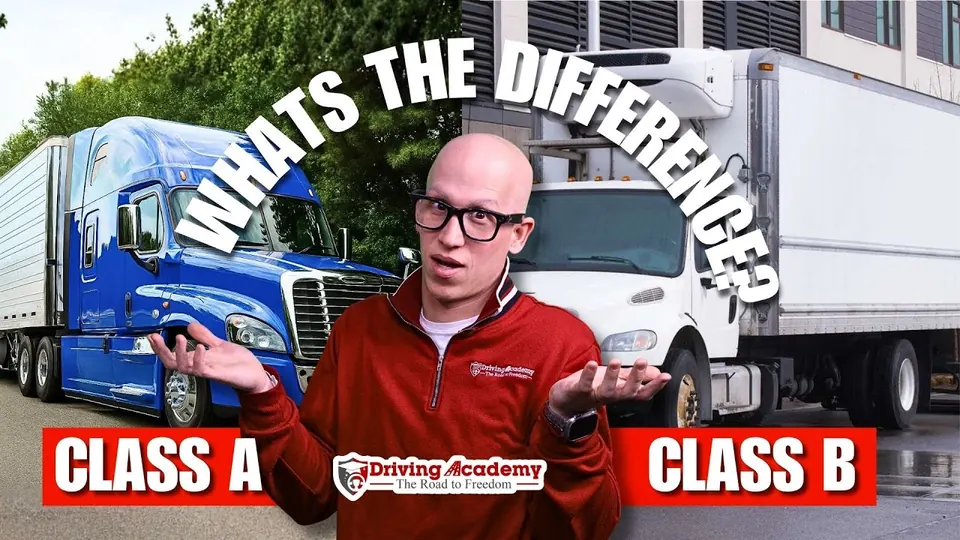
A Class A CDL covers combinations with a gross combination weight rating of 26,001 lb or more when the towed unit is rated over 10,000 lb, such as a tractor-trailer. A Class B CDL covers single vehicles rated 26,001 lb or more, which may tow a unit rated 10,000 lb or less. With the required endorsements, a Class A holder may also drive Class B and C vehicles.
Key facts
- The weight ratings count, not what the vehicle weighs on the day of the skills test. 49 CFR 383.133
- Testing in a vehicle with a pintle hook instead of a fifth wheel brings restriction O; an automatic transmission brings E. 49 CFR 383.95
- Class A training includes coupling and uncoupling; Class B holders upgrading to A may take the shorter theory upgrade curriculum. 49 CFR Part 380, Appendix A
- A Class B holder may drive Class C vehicles with the required endorsements. 49 CFR 383.91
You must hold a Class A CDL to drive a combination vehicle with a combined weight rating of 26,001 pounds or more. If you have a trailer rated over 10,000 pounds, you may be driving a combination vehicle. A Class B CDL can be used to drive single vehicles rated 26,001 pounds or more.
What Class A and Class B cover
| Class A | Class B | |
|---|---|---|
| What it covers | Any combination with a GCWR of 26,001 lb or more, when the towed unit has a GVWR over 10,000 lb | Any single vehicle with a GVWR of 26,001 lb or more |
| Towing | Towed unit rated over 10,000 lb GVWR | Towed unit rated 10,000 lb GVWR or less |
| Letter on the license | A for Combination Vehicle | B for Heavy Straight Vehicle |
| Common examples (Washington DOL) | Truck and trailer combos, tractor-trailers, flatbeds, livestock carriers, tankers | Delivery box trucks, school buses, public transportation buses, dump trucks with small trailers |
| Lower classes you may drive | Class B and Class C, with the required endorsements | Class C, with the required endorsements |
| Entry-level training curriculum | Appendix A, combination vehicles; includes coupling and uncoupling; behind-the-wheel in a Class A vehicle | Appendix B, heavy straight vehicles; no coupling unit; behind-the-wheel in a Class B vehicle |
| Skills test vehicle | A combination vehicle that meets the Group A definition | A heavy straight vehicle that meets the Group B definition |
In Washington, box trucks are one of the Class B vehicles.
Keep in mind that you will need to look at the weight rating set by the maker as part of determining the class. You don't have to weigh the truck.
Driving lower classes
You get to drive Class B and Class C vehicles with a Class A license. The more endorsements you have on your license, the more vehicles you can drive.
For Class B, the federal rule says: "A driver who has passed the knowledge and skills tests for a heavy straight vehicle (Group B) may operate any small vehicle (Group C), provided that he/she possesses the requisite endorsement(s)." 49 CFR 383.91
Passing the Class B test does not mean you can drive a Class A vehicle, however.
The skills test and what Class A adds
After you pass the CDL knowledge test, you'll move on to the skills test in a vehicle of the class you want and eventually, on the road.
For the test vehicle, the federal skills test rule says "the vehicle's gross vehicle weight rating or gross combination weight rating must be used, not the vehicle's actual gross vehicle weight or gross combination weight." 49 CFR 383.133
You'll be learning the rules of the road for combination vehicles as well as how to couple and uncouple a tractor and trailer. Expect some book work and training in coupling procedures and pre-trip inspections.
Restrictions from the test vehicle
Beware of a truck that doesn't have air brakes or a manual transmission; it may very well put a restriction on your license. The truck you test in may force you to accept a restriction code O based on a pintle hook.
The federal rule on restrictions says: "If an applicant performs the skills test in a combination vehicle for a Group A CDL with the power unit and towed unit connected with a pintle hook or other non-fifth wheel connection, the State must indicate on the CDL, if issued, that the person is restricted from operating a tractor-trailer combination connected by a fifth wheel that requires a Group A CDL." 49 CFR 383.95
Even the best training can't protect you if you've already taken the skills test in a vehicle that leads to a restriction code O.
| Code | Printed meaning | When federal rules apply it |
|---|---|---|
| E | No manual transmission equipped CMV | Skills test in a vehicle with an automatic transmission |
| L | No air brake equipped CMV | Failed the air brake part of the knowledge test, or skills test in a vehicle without air brakes |
| Z | No full air brake equipped CMV | Skills test in a vehicle with air over hydraulic brakes |
| O | No tractor-trailer CMV | Class A skills test in a combination connected by a pintle hook or other non-fifth-wheel connection |
Training for Class A and Class B
Entry-level driver training is usually required for both classes today. One of the first things you'll need to do before you take the skills test is to get entry-level driver training from a listed provider. You can check by using the FMCSA training provider database or reviewing your state's licensing requirements online.
The two training programs have differences which may be important to you. Class A training includes coupling and uncoupling, and the Class B program does not.
The Class A curriculum in the federal training rule says: "Driver-trainees must demonstrate proficiency in proper techniques for coupling, inspecting, and uncoupling combination vehicle units, as applicable." 49 CFR Part 380, Appendix A
Upgrading from Class B to Class A
Be aware that if you plan to upgrade from a Class B to a Class A CDL, you will need to pass the Class A tests. You must take the Class A test in a combination vehicle. Keep in mind that you will need to get a commercial learner's permit as part of upgrading from Class B to Class A.
The same curriculum says: "Class A CDL applicants who possess a valid Class B CDL may complete the Theory Instruction Upgrade Curriculum in lieu of the Theory Instruction Standard Curriculum." 49 CFR Part 380, Appendix A
Once the classroom part is completed, you are not done with the behind-the-wheel part. You should also ask about how much the training will cost and how long it will take.
Video
Frequently asked questions
Are the 26,001 and 10,000 pound figures actual weights?
These weights refer to the rating set by the maker, not the actual weight on a given day.
Do I need an endorsement to pull doubles or triples?
In addition to a valid CDL, drivers must also obtain a T endorsement to pull doubles or triples. You don't have to take a new skills test to do this.
Do I have to learn coupling for a Class A CDL?
You'll need to learn to couple and uncouple a tractor and trailer, whether you like it or not.
Sources
- 49 CFR 383.25, Commercial learner's permit (eCFR) ecfr.gov checked
- 49 CFR 383.91, Commercial motor vehicle groups (eCFR) ecfr.gov checked
- 49 CFR 383.93, Endorsements (eCFR) ecfr.gov checked
- 49 CFR 383.95, Restrictions (eCFR) ecfr.gov checked
- 49 CFR 383.111, Required knowledge (eCFR) ecfr.gov checked
- 49 CFR 383.133, Testing methods (eCFR) ecfr.gov checked
- 49 CFR 383.153, Information on the CLP and CDL documents and applications (eCFR) ecfr.gov checked
- 49 CFR 380.609, General entry-level training requirements (eCFR) ecfr.gov checked
- 49 CFR Part 380, Appendix A, Class A CDL training curriculum (eCFR) ecfr.gov checked
- 49 CFR Part 380, Appendix B, Class B CDL training curriculum (eCFR) ecfr.gov checked
- Washington State Department of Licensing, Types of CDLs dol.wa.gov checked
Published November 27, 2026. Rules, quotes and figures checked against the official sources on November 27, 2026. This guide explains the rules; it is not legal or medical advice. Confirm with your state licensing agency or FMCSA.